The central question: speed vs. sustainable growth
Introduction: The 2025 growth dilemma for South African businesses
For small and medium-sized enterprise (SME) owners across South Africa, the year 2025 presents a familiar yet intensified challenge: the relentless pursuit of growth in a complex economic environment. Navigating the digital landscape is no longer a choice but a necessity for survival and expansion. However, with limited resources, tight budgets, and fierce competition from larger corporations, every marketing decision carries significant weight. This reality brings business owners to a critical crossroads, defined by one central question: when it comes to digital marketing, should the focus be on Search Engine Optimisation (SEO) or Google Ads?
This is not merely a technical debate between two marketing channels. For the South African business owner, it represents a fundamental strategic dilemma. It is a choice between the urgent need for immediate leads and cash flow—the lifeblood of any SME—and the strategic imperative to build a sustainable, long-term asset that generates value for years to come. The decision pits the raw speed of paid advertising against the compounding power of organic growth.
The decision between SEO and Google Ads is fundamentally a decision about a business's financial and operational priorities.
The choice is particularly acute in the South African context, where many SMEs grapple with a lack of financial reserves and insufficient marketing skills, making the risk of a poor investment particularly high. They need a clear path forward, one that acknowledges their unique pressures and provides a data-backed roadmap for success. This guide moves beyond generic advice to deliver an exhaustive analysis tailored specifically for the South African market. It will dissect the timelines, costs, and return on investment (ROI) of both SEO and Google Ads, explore the transformative impact of new AI-driven search technologies, and provide a clear, actionable blueprint for different business types.

Google Ads: Your on-demand lead generation engine
Google Ads, formerly known as Google AdWords, is Google's pay-per-click (PPC) advertising platform. In the simplest terms, it operates on a "pay-to-play" model. Businesses bid on specific keywords for the opportunity to have their ads appear at the top of Google's search results page, instantly placing them in front of potential customers who are actively searching for their products or services. This can be likened to renting a prominent billboard on the busiest digital highway in the world.
The primary and most compelling advantage of Google Ads is speed. Unlike the slow, gradual build-up of SEO, a Google Ads campaign can be conceptualized, created, and launched in a matter of hours, driving traffic to a website almost immediately. For a South African business launching a new product, running a seasonal promotion, or simply needing to fill its sales pipeline quickly, this immediacy is invaluable.
Beyond speed, Google Ads offers an unparalleled level of control and precision. Business owners have direct command over nearly every aspect of their campaigns, including message control, budgetary control, and targeting control. This is where Google Ads becomes a powerful tool for local South African businesses. A plumber in Johannesburg can choose to show ads only to users in Sandton and Randburg. A boutique hotel in the Cape Winelands can target potential tourists in Gauteng and KwaZulu-Natal. This hyper-local targeting ensures that marketing spend is focused on the most relevant audience possible.
The flow of traffic and leads is directly proportional to ad spend. The moment the budget is paused or exhausted, the ads disappear, and the lead flow stops instantly.
However, this speed and control come with a significant trade-off. The "instant noodle" nature of Google Ads creates a direct and immediate dependency on budget. You are paying for temporary access to visibility, but you are not building any lasting equity. Each click has a cost, and that cost must be paid continuously to maintain results, making it a powerful tool for short-term goals but a potentially fragile and expensive strategy when used in isolation.

SEO: Building your business's most valuable digital asset
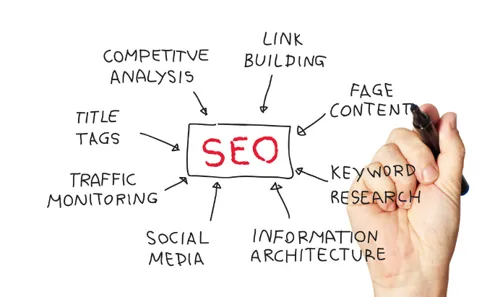
Search Engine Optimisation (SEO) is the strategic process of improving a website's visibility in the organic (non-paid) search results. It is about earning trust with both users and search engines like Google, rather than paying for placement. If Google Ads is like renting a billboard, SEO is like buying the land and building a flagship store that attracts customers naturally over time. It is a long-term investment, often compared to planting an oak tree—it takes time to grow, but once mature, it provides immense, lasting value.
The most significant difference between SEO and Google Ads lies in the nature of the results. SEO builds a compounding digital asset. A single, well-researched blog post or a properly optimized service page can rank in Google for years, generating a continuous stream of "free" traffic and leads long after the initial investment in its creation has been made. This traffic is not dependent on a daily advertising budget.
Users are more likely to trust and click on organic search results than on paid ads, which are often viewed with skepticism or ignored altogether.
Crucially, this organic visibility comes with a powerful psychological advantage: trust. Studies indicate that 70-80% of searchers ignore paid ads, focusing exclusively on organic results. This inherent credibility means that the traffic generated from SEO is often of a higher quality, leading to better conversion rates and more qualified leads.
For a South African SME, this long-term perspective transforms SEO from a simple marketing tactic into a powerful form of business risk mitigation. The country's economy can be volatile, and businesses often operate with limited financial buffers. A reliance solely on Google Ads, with its escalating costs and on/off nature, exposes a business to significant risk. In contrast, a business with strong SEO has a foundational baseline of organic traffic that continues to generate leads regardless of the daily ad spend. This makes the business more resilient and adaptable. Therefore, investing in SEO is not just about getting "free clicks"; it is a strategic decision to build a durable, valuable asset that de-risks the business from future market shocks and budget constraints.
The financial reality: a head-to-head cost & ROI analysis for the SA market
The financial litmus test: upfront vs. ongoing costs
For any South African SME, the decision between SEO and Google Ads inevitably comes down to budget. The two approaches present a stark contrast in financial outlay and timing, creating a classic paradox for a business sensitive to cash flow. SEO is characterized by a significant upfront investment of both time and resources. While there is no direct fee paid to Google for each click, the costs are associated with the foundational work required to build authority and relevance, such as technical audits, content creation, and link building. In South Africa, monthly retainers for professional SEO services can start from around R3,800 and go upwards of R13,000 or more.
Google Ads, on the other hand, offers a lower barrier to entry from a cost perspective. A business can technically start a campaign with a very modest budget. However, this initial accessibility masks the true nature of its cost structure: it is a continuous, ongoing operational expense. The core cost is paying for every single click, and if working with an agency, there will be a monthly management fee. For a professional agency in South Africa, this fee is likely to start around R7,500 per month, with a recommended minimum ad spend of R3,000 on top of that, bringing the minimum total investment to over R10,500 per month.
This creates a critical paradox for the South African SME. The channel that is ultimately more cost-effective in the long run (SEO) demands a higher upfront financial commitment, while the channel that is easier to start with a small budget (Google Ads) can evolve into a more expensive, perpetual cost. This forces a difficult decision: can the business afford the one-time investment for long-term savings, or does it need the low initial friction of a model that may prove unsustainable?
What do Google Ads really cost in South Africa? (A 2025 snapshot)
Moving from theory to tangible numbers is essential for any business owner planning a marketing budget. The cost of Google Ads is not uniform; it fluctuates dramatically based on several key factors specific to the South African market. The average cost-per-click (CPC) can range from as little as R5 for less competitive terms to over R200 for highly sought-after keywords in lucrative industries.
The primary factors influencing your CPC in South Africa include industry competition, keyword selection, geographic targeting, and your Ad Quality Score. To provide a concrete benchmark for South African businesses, the following table synthesizes available data on average CPCs across various local industries. These figures are estimates for 2025 and should be used as a guide for financial planning.
| Industry | Average CPC (Search) in ZAR |
|---|---|
| Legal & Mediation | R14.58 - R58.18+ |
| Construction & Trades | R13.27 |
| IT Support & Repairs | R21.34 |
| Finance & Insurance | R55.27 - R61.05+ |
| Auto Repairs & Services | R17.44 |
| Health & Medical | R4.74 - R40.47 |
| Renewable Energy | R19.96 |
| Consumer Services | R12.42 |
| B2B Services | R9.46 |
| Education | R6.57 - R50.66 |
| E-commerce | R1.91 |
The long-term ROI: where your marketing Rand goes furthest
While Google Ads offers speed, the ultimate measure of any marketing investment is its return. When analyzing the long-term Return on Investment (ROI), the financial case for SEO becomes overwhelmingly compelling. While it requires patience, SEO is structured to deliver compounding value that far surpasses the linear returns of paid advertising.
Viewing SEO not as a marketing expense but as an asset-building activity is crucial.
Data consistently shows that SEO yields a significantly higher ROI over time. One study focusing on the trades industry found a staggering difference: for every dollar spent, SEO returned $19.90 in revenue, while paid ads returned only $4.40. This is because once a website achieves high rankings for its target keywords, it continues to receive traffic and leads without having to pay for each click. The upfront cost is amortized over years of sustained performance, drastically reducing the effective customer acquisition cost over the lifetime of the asset.
This financial dynamic fundamentally reframes the SEO investment. A marketing budget is typically viewed as an operational expense, an accurate description of Google Ads spend. However, an investment in SEO is more akin to capital expenditure used to acquire a long-term asset. Through the creation of durable content and the building of website authority, SEO creates a digital property that the business owns. This "digital real estate" has a tangible economic value and is expected to provide future economic benefits in the form of a continuous, low-cost lead flow.
The 2025 game-changer: AI and the future of search in South Africa
Beyond the ten blue links: welcome to the era of AI answer engines
For years, the Google search results page has been a familiar landscape of "ten blue links." That era is rapidly coming to an end. The familiar search experience is being fundamentally challenged, not just by Google itself, but by a new wave of powerful competitors. The rise of conversational AI, pioneered by platforms like OpenAI's ChatGPT and integrated directly into search by competitors like Microsoft's Copilot, has ignited a fierce innovation race. This competitive pressure is forcing Google to accelerate its own transformation, rapidly moving from a search engine to an answer engine.
This evolution is most visible in Google's AI Overviews. Instead of simply providing a list of links, Google now uses generative AI to create a comprehensive, conversational summary directly at the top of the search results page. This AI-powered snapshot synthesizes information from multiple web pages to provide a direct answer, potentially reducing the need for users to click through to any single website. For local South African businesses, the implications are profound. When a user searches for "best plumbers in Durban," Google will generate a summary that pulls information directly from businesses' online profiles, with a heavy emphasis on Google Business Profile (GBP) data and customer reviews.
The AI-driven future of search is not on the horizon; it is at the doorstep.
This isn't just a corporate evolution; it's a direct response to the global AI race, and South African business owners should not dismiss it as a distant trend. Google's recent and significant investment in establishing its first Google Cloud region in South Africa is a clear signal of its strategic intent. This infrastructure is the essential backbone that powers the deployment of its own AI-first products, like AI Overviews and Gemini, to the local market. The presence of this local infrastructure creates a powerful sense of urgency.

Optimizing for tomorrow: is your business ready for "answer engine optimization"?
The rise of AI-driven answer engines—whether from Google, Microsoft, or new players—does not mean SEO is dead. On the contrary, it raises the stakes and rewards businesses that are already practicing high-quality, user-focused SEO. The goal is no longer just to rank, but to become the authoritative source that all AI models, including Google's, use to formulate their answers. Fortunately, preparing for this shift does not require abandoning existing strategies. It involves doubling down on the foundational principles of good local SEO.
Your Google Business Profile is no longer just a listing; it is your primary digital storefront and a critical data source for AI.
It is absolutely essential to claim, verify, and meticulously optimize your profile. This includes ensuring your Name, Address, and Phone number (NAP) are 100% consistent across the web. AI search actively synthesizes customer reviews, so a proactive review generation strategy is more important than ever. The content on your website must be structured to directly answer the questions your customers are asking. Finally, embrace E-E-A-T (Experience, Expertise, Authoritativeness, Trustworthiness) by showcasing your real-world experience, creating helpful content, building authority, and ensuring your site is trustworthy and secure. Ultimately, preparing for AI search is the logical evolution of what it means to be a trusted source of information online—a principle that will be rewarded by any answer engine, not just Google's.
The strategic blueprint: which channel first for your business type?
The "which channel first?" decision matrix for SA businesses
After analyzing the mechanics, costs, and future trajectory of both SEO and Google Ads, the analysis must pivot from the theoretical to the prescriptive. The optimal starting point is not the same for every business. It depends entirely on the business model, the urgency of its need for leads, and the nature of its customer journey. To provide direct, tailored advice for South African SMEs, the following decision matrix has been developed. It serves as a strategic blueprint, allowing a business owner to identify their specific situation and receive a clear, expert-backed recommendation on where to focus their initial marketing budget and efforts.
| Business Type | Your Primary Goal | Start With | Scale With |
|---|---|---|---|
| Local Services (Plumbers, Electricians, Attorneys) | Immediate phone calls and high-intent leads from local customers. | Google Ads (Search & Local Service Ads) | Local SEO (GMB, Map Pack, Reviews) |
| E-commerce Stores | Quick product sales and immediate revenue. | Google Ads (Shopping & Retargeting) | Product & Category Page SEO |
| B2B & Professional Services | Generate high-value, qualified leads from decision-makers. | SEO & Content Marketing | Google Ads (Retargeting & Branded) |
| High-Trust Professions (Medical, Financial) | Build credibility and generate new patients or clients. | Google Ads (Carefully targeted search) | E-E-A-T Focused SEO |
This matrix clarifies that for businesses needing immediate, transactional customers—like a local tradesperson—Google Ads is the undisputed champion for speed. Conversely, for businesses with long sales cycles built on trust and education, such as a B2B consultancy, SEO is the more logical and effective starting point.

The unbeatable hybrid strategy: using ads and SEO together
While the decision matrix provides a starting point, the ultimate goal for any business serious about growth is not to choose one channel over the other, but to create a powerful, synergistic system where SEO and Google Ads work together. This hybrid approach allows a business to dominate its market by leveraging the short-term strengths of paid ads to accelerate the long-term benefits of SEO, creating a marketing engine that is far more robust and profitable than either channel operating in a silo.
The ultimate goal... is not to choose one channel over the other, but to create a powerful, synergistic system where SEO and Google Ads work together.
This integrated strategy creates a virtuous cycle where each channel makes the other more effective. By running a targeted ad campaign, a business can quickly test which keywords and headlines generate the most conversions. This invaluable, real-world data can then be used to inform and prioritize the long-term SEO content strategy, making it faster, cheaper, and less reliant on guesswork. When a potential customer searches for a key term and sees a business appear in the paid ad section, the local map pack, and the top organic results, it creates an undeniable impression of authority and market leadership. This "SERP domination" builds immense trust and significantly increases the likelihood of capturing the click. As the SEO strategy matures and organic rankings improve, the business can strategically reduce its ad spend for certain keywords, creating a more resilient, adaptable, and cost-effective marketing ecosystem.
Your next step: from information to action
The real challenge for SA SMEs: finding the right expertise
This report has established a clear framework for understanding and choosing between SEO and Google Ads. However, for the average SME owner, the greatest challenge is not a lack of information, but a lack of three critical resources: time, budget, and specialized skills. Research into the South African SME sector consistently reveals a significant gap in marketing capabilities. Many business owners are forced to be the CEO, CFO, and head of operations simultaneously, leaving little time to dedicate to the complexities of digital marketing.
The greatest challenge is not a lack of information, but a lack of three critical resources: time, budget, and specialized skills.
The reality is that trying to become an expert in SEO, Google Ads, and the emerging field of Generative Engine Optimization while also running the core functions of a business is not just difficult; it is often inefficient and counterproductive. A poorly managed Google Ads campaign can burn through a budget with zero return, while a flawed SEO strategy can waste months of effort with no improvement in rankings. The logical conclusion for a business owner who is serious about growth is that the most efficient and effective path to success is to partner with a vetted professional who already possesses the requisite expertise.

How to get expert digital marketing & SEO quotes without the hassle
The process of finding, vetting, and choosing a digital marketing agency can be a daunting and time-consuming task in itself. It involves hours of searching, reading reviews, and trying to compare quotes from agencies with different pricing models and service offerings. For a time-poor business owner, this friction is often a major barrier to taking action.
This is precisely the problem that a platform like Procompare.co.za is designed to solve. It acts as a bridge, connecting businesses in need of professional services with a network of vetted, local South African experts. The value proposition is simple yet powerful: instead of the business owner having to hunt for agencies, Procompare brings the qualified agencies to the business owner.
The platform streamlines the entire procurement process into a few simple steps, directly addressing the core challenges faced by SMEs. It saves time by replacing hours of research with a single request. It saves money by allowing for easy comparison of up to 6 competitive quotes. And it reduces risk by providing access to a network of verified professionals with client reviews and ratings. This model is the perfect antidote to the specific marketing procurement challenges that plague South African SMEs. It removes the friction, uncertainty, and time-suck from the process, making it significantly easier for a business to move from decision to implementation.
Final call-to-action: Get your free, no-obligation marketing quotes now
The analysis is complete. The strategies are clear. The path from information to action is now laid out. For South African business owners ready to stop guessing and start growing, the next step is to understand what a professional, results-driven digital marketing strategy will cost for your unique business.
By leveraging a streamlined procurement platform, you can gain clarity on budget and connect with top-rated local experts who can translate these strategies into tangible results—more traffic, more leads, and more growth.
Ready to find your expert marketing partner?